So How'd the Kickstarter Go?
Experiences and notes from a successful first crowdfunding campaign
Between the 4th of October and the 4th of November last year, I ran a Kickstarter to fund publication of my science fiction novel Sunward Sky. I wanted to compile a review of my experiences for those who may also be considering the crowdfunding of their own book, with ideas and pitfalls of the process. This is all my own notes from my own experience so your experience may vary, but I hope some may find it helpful.
I have self-published a couple of things before but they are smaller works and I didn’t promote them at all (and subsequently they didn’t sell), so this can be considered a “debut” novel of sorts. I certainly didn’t have an existing audience of any particular size.
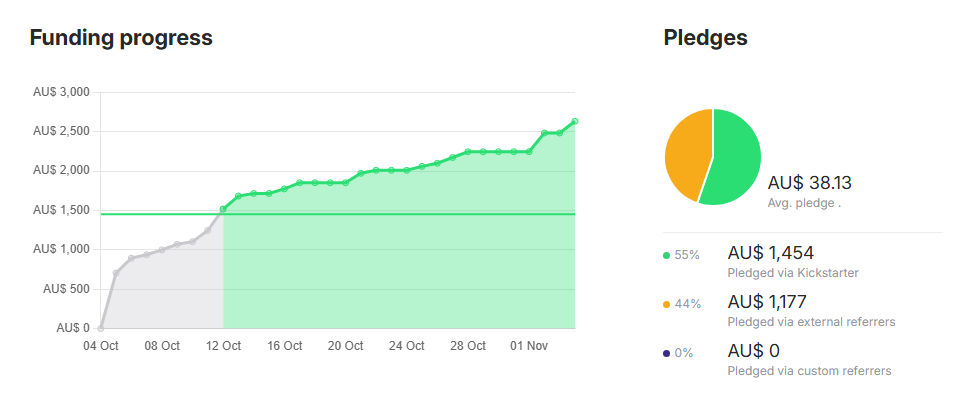
The project was funded by 69 backers (nice) and raised a total of AUD$2,631, constituting 181% of the funding goal.
This is a long post, so I’ve broken it up into sections to hopefully help people find specific information. All costs are in Australian Dollars (AUD$)
Context/ The Project
The novel I self-published began life as a podcast audio fiction project in 2020 and 2021. The story was published in a first draft form using Anchor.fm (now Spotify for Podcasters), where I would write a chapter, then record it and push it out into the world. It was a lockdown project that gained a reasonable amount of traction, gaining more than 70,000 downloads by the time I decided to do the Kickstarter.
The decision to turn it into a novel was mainly to turn the fairly nebulous product of a podcast into a tangible object. It was, after all, a fair amount of work and I thought it would be nice to have it embodied into a physical product, to mark the culmination of the project.
Why Kickstarter?
For most publishers, there is a stipulation that a work will not be taken on if it has been published previously. As the podcast already existed and was out in the world, I assumed this constituted a previously published work. Therefore, I wanted to explore opportunities for self-publishing.
Kickstarter presented an opportunity to gauge interest in a project prior to going through all of the processes of formatting, buying ISBNs, printing costs, and the labour intensive task of actually preparing the book. In my mind, it meant I could get the project to the point of “break-even”, from which I could build it into further campaigning for the release on the major publishing platforms.
Setup/Pre-Planning
To incentivise people into supporting the Kickstarter, the idea was to produce a “Special Edition” version of the book. This would entail:
-Larger Format Paperback (6” x 9” instead of the standard edition 5” x 8”)
-Unique Cover Art
-Foreword in which I describe the writing process and inspiration for the work.
-Names of backers in a thank you section.
-Limited number of special edition copies (only 100 were printed, and they won’t be available anywhere else)
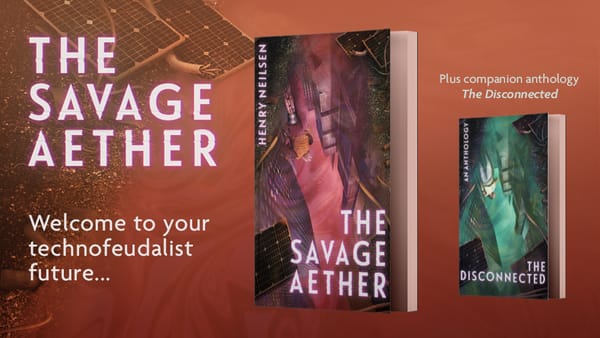
I engaged Jon Stubbington to produce the image for the cover (he prepared the standard and special edition covers), and he also produced a series of promotional images for me.
I also did a thorough rewrite of the whole book. The podcast it was a reasonably clean first draft, but it needed to be better if I was going to be happy to have it in print forevermore. So a thorough second and third draft was completed prior to the launch of the Kickstarter.
I recorded a promotional video talking about the Kickstarter which I used as an instagram reel, a youtube video, a facebook video, and the video on the Kickstarter page itself. This was filmed with a decent quality webcam and OBS, and I edited it with Da Vinci resolve, which is a free download (but you need a decent computer to run it).
I then set up the project pre-launch page, and contacted… pretty much everyone I know and asked them if they would be interested in signing up. A total of 81 people signed up, which gave me a ballpark estimate of how many books I could sell. I estimated that approximately 75% of them would follow through and purchase a book. More on the pre-launch in the lessons learned section.
Goal Setting
In order to understand how much I would charge per book, I made some assumptions about costs, and I researched certain areas more than others.
Each book costs approximately 24 dollars to print and send to my house. I used Ingramspark’s printing and shipping calculator, and assumed a 300 page product (the final page count was 296, so pretty close!). I wanted to sign copies for the backers, so I counted on shipping to my house and then shipping overseas. This would mean double shipping (first to my house, then the backers), so I made the base cost 25 dollars.
Kickstarter takes approximately 10% of the total cost as their processing fee, so I increased the cost by $2.50 and rounded up, to a total of $28.
For ebooks, I looked at the costs of most of the recent ebooks I found and set a price of $11, which seemed in line with other projects on the platform. It also lines up with an $8.99 ebook which is fairly typical for Kindle and similar stores, plus a 10% Kickstarter markup.
Postage was a confusing one., I assumed a $5 domestic postage rate and a $10 overseas postage rate. This was a mistake which I will expand in the lessons learned section.
I assumed 50% of people would buy a physical copy, with 50% preferring to get the ebook. Including domestic shipping on the physical book values and rounding up, that meant a goal of $1400. I think I ended up rounding it to $1450, assuming I would have some contingent of overseas buyers.
I calculated on this basis that I would need to sell $2600 to cover all the outlay on the artwork, so I made it my first stretch goal.
My second stretch goal was to make enough to hire someone to produce an ebook, which I estimated at $4500.
Promotion/The Kickstarter
On October 4th, I hit “Launch” on the Kickstarter. I promoted on Substack (~100 subscribers), facebook (~600 connections), and author instagram (~400 followers). I also posted on twitter and bluesky. Simultaneously, I was doing final copy editing and proofreading of the draft, as well as formatting once the kickstarter funded, which it did in just under a week.
I posted on socials pretty much every day, with short videos or just images talking about where the project was up to. Consistently posting works. The days I didn’t post were always the days I didn’t get any further backers.
I didn’t do any paid promotions in that time, though I did record some stuff for the podcast to let followers know that the kickstarter was happening. I’m unclear on whether that resulted in conversions.
Costs and Income
I am not including costs for formatting software or writing software as these are things I already had and I am assuming writers will also have access to. I write in Scrivener and formatted in Microsoft Word (and Atticus for Epub).
-Cover Art and Marketing Collateral: $708.02 (this is for two covers for both epub and paperback, and a series of marketing images)
-ISBNs (paperback and ebook): $20.00
-Proof Copy from Ingram: $24.02
-100 Print Copies of Special Edition: $1,182.68
-100 Postage Satchels: $104.00
-Shipping: $455.05
-Launch Party (Tab Behind Bar): $316
Total Costs: $2809.77
-Total Kickstarter Income (After Kickstarter Cut and 3 Dropped Backers): $2293.61
-Subsequent income from Post-Kickstarter special edition sales: $970.92
Total Income: $3,444.69
Net: $454.76
Note that this is up until this date - I still have about a dozen copies of the “special edition” left which I’m hoping to sell at book fairs locally this year. At this point, I now have a modest marketing budget and some leftover for my next project, which is very nice.
Lessons Learned
I was relatively well prepared for my Kickstarter experience, so it went fairly smoothly. I did a lot of groundwork and a lot of research but there are definitely things I could have done differently or better. Here are a few things you can look out for when you do your own.
Pre-Launch Conversions: Of the 81 people who signed up for the project at pre-launch, only 37 actually ended up backing the project. I expected some attrition (it’s easier to hit one button than actually pledge money) but it was higher than expected. Some people I know told me that they never actually received notification from Kickstarter that the project had launched. I’m not sure how much value the pre-launch phase actually got me in hindsight.
Postage Costs: Figure out what your postage costs are. If possible, get a confirmation from the shipping company. I used Australia Post and I had such a bad time. I have gone to the Post office five times in the process of this project, and each time I have been charged or advised a different price. One time I didn’t have to do Customs declarations, another time I did. It’s confusing, and it’s a large portion of the overall budget. I will be researching more thoroughly next time. Though admittedly, the service from Australia Post was so bad that I’ve lodged a formal complaint, so my experience may have been worse than usual.
ARCs: I tried to get ARCs for my book through both Reedsy Discovery and Booksprout. Booksprout was a decent service and I can recommend it (though I only got the one review), but I wouldn’t recommend Reedsy Discovery. I’m also not sure that ARCs helped the Kickstarter. Maybe if I’d got them earlier and could use them as marketing it would have helped more.
Mental Load: The process of watching the line go up is stressful. If you are able, take the first few days of the campaign off work or try to move things around to make it easier on yourself. I was constantly refreshing it, and I was freaking out every time the pledges slowed down. Have someone you can talk to, take time away from the internet, and take care of yourself mentally.
Dropped Backers: If people pledge but aren’t able to pay when the campaign ends, they become dropped backers and you don’t get that portion of the funding from Kickstarter. The home page will not reflect money you don’t get from dropped backers. This happened with a few of my pledges and I had a little less money hit my account than I expected.
Late Pledges: I would highly encourage enabling late pledges on your Kickstarter campaign. As noted in the income section, I have made almost an additional one thousand dollars in sales since the campaign ended from people who didn’t realise it was happening, or didn’t realise the campaign was ending. Keeping it open for stragglers is something I’ll definitely do next time.
People Love a Physical Special Edition: I estimated that my sales would be split about 50/50 for ebook/physical print. The reality was about 85% of people got physical copies. I would make adjustments and calculations based on physical sales in future.
Do a Launch, mark the occasion: The best thing I did was hire a room at a local pub, put some money behind the bar, and held a book launch. It was fairly low key, but it was excellent to mark the occasion and I highly recommend doing it.
You kind of have to start again for standard publishing: One of the things I didn’t take into account was the way that Amazon and other bookstores rely on pre-sales to move the needle when a book launches. I’m now a month away from the wide launch of the book and have only got a single pre-sale on Amazon, so I need to ramp up marketing again. This is fine, it’s just something to keep in mind if you’re hoping to make further sales on Amazon.
Unexpected Bonuses
While merely funding the Kickstarter was great, there were other bonuses that I didn’t really expect!
Meeting New People: Through the Kickstarter, I was messaged by a fellow writer who lives in my city, who had stumbled upon my campaign while he was researching his own. He and I messaged back and forth and I now have a new friend in writing, AND I’ve been invited into a writing group of like-minded people in my city. I’ve subsequently backed his Kickstarter and look forward to reading his book.
Meeting Old People: One of the backers messaged me, and it turns out that she was someone I worked with more than 20 years ago when I was in a high school job. An absolutely wild connection to make, but I was so glad that I was able to reconnect with someone and I hope we stay in touch.
People are actually pretty great: Putting your work out there is, in a word, terrifying. Novels take a long time, and they’re revealing of your character even if you don’t intend them to be. However, if you have a supportive and interested network I think most people are genuinely excited to support the art of people they follow, so don’t be afraid to try! Just make sure your product is the best you can possibly make it and you’ll be rewarded.
I hope this information is useful for people, and I hope it gives some context for how to run a Kickstarter of your own. It’s extremely hard work, but it’s a very rewarding process and I would definitely do it again, maybe smarter this time.
Any questions shoot me a message in the comments!