Gorillaz, and the Dance for the End of the World
Sometimes, the experience of seeing a band transcends your expectations of a what a concert is, and becomes itself a piece of performative…

Sometimes, the experience of seeing a band transcends your expectations of a what a concert is, and becomes itself a piece of performative art. The canvas is the venue, the audience the medium, and the work is elevated in its ability to draw parallels to your lived experience.
This was the experience I had when I saw Damon Albarn’s postmodern electro-pop group Gorillaz perform in Melbourne recently. I found myself standing amid an audience while a coercive, horrific beauty thrummed outward and encapsulated me. I have seen a lot of live bands in my time, but Gorillaz will stand out for a long time as one of, if not the most, affective pieces of multimedia art performance I’ve ever seen.
I’m going to attempt to draw a line here. A connection between the feelings I was carrying that night amongst the crowd and experiences I’ve had recently about the way we as humans are currently interacting and engaging with the world around us and each other.. Just be aware that I’m not intending this as an argumentative piece at all. It’s my reflections on lived experience, being shone through the lens of a concert that I don’t think I’ve quite walked away from yet. It’s barely an essay, and not really a review. It’s a lament. My own maniacal laughter in the dark as the diegetic rhythm fades around me.
“Hello, is Anyone There…?”
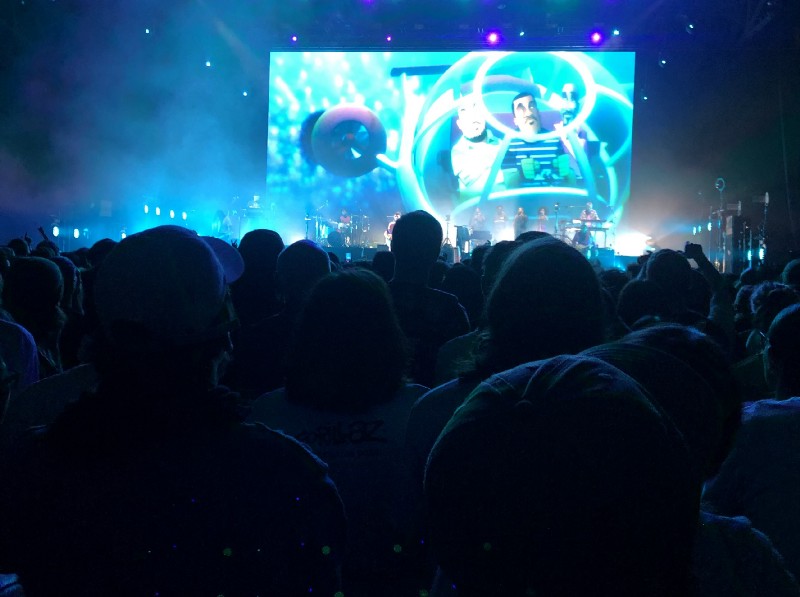
Albarn looks tired and drawn even by the end of M1A1, the first song of the night and the last song from their eponymous 2001 album. Before we see him, we feel the music. The drumbeat crushes your chest and drives into the base of your spine, while the Romero quote of “Is anyone there?” rings repeatedly throughout the stadium and the crowd cries in response. Lights flash and the band is cheered onto the stage, but the cry continues to repeat as Albarn joins the pre-recorded vocal line, sending his own lonely cry out into the screaming black of the crowd shouting back at him. It seems interminable, but finally, the song begins in earnest and the cry for help is replaced with the monotonous “la la la la la la la la la hey!” refrain. It sets up an affect very early on that the show will continue to have on me: alone in the revelling crowd. Helpless.
The eerie cry I heard in that performance came back to me in a shopping centre days later. The room full of people crying out their response, “Is anyone there?”. We were here, and we said so, but you asked again and again. Every place I entered was staffed by bottom rung employees of franchises owned by corporate entities under subsidiaries and publicly traded shareholdings. My recourse as a consumer, should any of these places be practising in a way that I found unfavourable, was so limited as to be meaningless. Nobody working in the shop has the ability to fix anything! Don’t be stupid. Hello! Is anyone there? The machinery of the organization is a muffle, a silencer and shield. Human interface is vanishing. In some places it’s completely gone. Try to complain to someone about the rudeness of an Uber driver, the lateness of a delivery order, the leak of your personal details and security information from a government mandated data-collection site. Ask to speak to the person who makes the decisions. Ask again and again, over and over. The respondent cry won’t be enough, so you’ll ask if anyone’s there in the dark. Again.
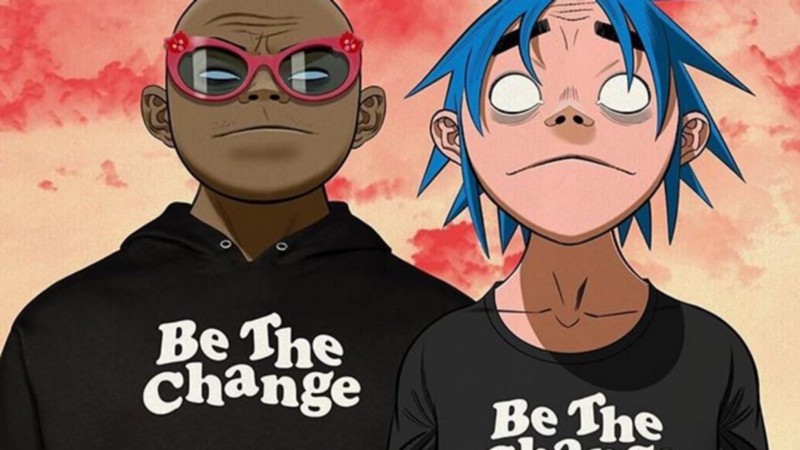
Damon drives this home. No acknowledgment, no choreographed connection with the crowd until the refrain comes in. When the song ends, a ball — perhaps the moon — hangs in front of the audience, its cratered face reading “Be The Change”. A call to arms for those who are present, and a note to those who aren’t.
The Absence of Voice.
The musicians on stage are amazing, and the texture of the music, along with the need for it to flow in time with the Audio Visual element of the show, mean that there is a lot of pads, and controls, and preloaded elements. This isn’t a criticism; though there’s a value to a shared display of virtuosity, I don’t get hung up on whether or not the entirety of the show is played live. It only felt conspicuous in a couple of places. These where when the band played arguably Gorillaz two most famous songs: Clint Eastwood, and Feel Good Inc.
In both of these cases, the hip hop artists who recorded the original (Del the Funky Homosapien and De La Soul, respectively) aren’t present, which is unsurprising; asking guest writers to come on tour two decades later is a big ask. However, the vocal tracks weren’t covered by any of the other backing members of the band: there were several artists at the concert, excellent rappers who could have easily filled in, but they didn’t. I suspect there was some legal reason for this, but it doesn’t really matter. What made me stop is the effect it had on the stage performance.
Being some of the biggest songs by the band, they were toward the back end of the show. As a result, the show had had almost its full run to have its effect on me. I was by this time drawn to the embodied sense of inevitable doom that the show had brought down on me, and I was watching nothing but the stage, over the top of the revelry occurring in front of me. As the backing tracks for both songs played, Albarn simply stood back from the microphone, throwing his hands to the side at a few key moments. Tired in both body language and voice, he’s stepping back for a well-earned moment’s reprieve. The musicians around him play on, and his creation seems out of his control. He stands, a small man on a huge stage in a giant auditorium, doing nothing but listening to the machinations he began some decades ago and watching the effect it’s had on the world. He’s us, as individuals. Held adrift and uncontrolled, in a dystopia of humanity’s creation. We can’t do anything but stand and wait and stare as the choices of the past wheel on. Before us the future, and the things we’ve surrounded ourselves with will continue on without us. We are surrounded, silently throwing our hands in the air, surrounded by the result of our own industry.
In a way, this is Albarn at his most animated. His attitude falls just short of carefree in this moment. Dancing recklessly, yet somehow still despondent. This is him, and for all he’s calling for us to be the change, he’s as trapped as the rest of us. He knows this. He told us earlier in the show. Just prior to playing “Last Living Souls” he declares:
“This song is about how fucked the world is. But let’s dance anyway!”
Cue the applause.
Juxtapose Imagery
The lyrical themes in Gorillaz songs are fairly bleak. Fire Coming out of the Monkey’s head is a parable about a town strip mining a mountain. Last Living Souls is exactly what it says on the tin. Numerous others, in their content or implication, are about the decisions humans are making on earth and how we’re ultimately sowing the seeds of our own destruction.
The bass in the stadium is loud, and it’s low. Between the kick drum, the low end of the bass, and synth and controller effects, the bassline hammers you relentlessly. After a short while it becomes oppressive, and when it’s tied with the imagery on the screen, of whimsical fantasy worlds being destroyed by World War II bombers and shots of whaling and discarded plastic, a creeping sense of horror drew over me. The frontman told us to dance, and dance we did, and all the while a gut-wrenching tale of unimaginable, wasteful and murderous excess played across enormous screens in front of us. Even the more upbeat songs featured violent car chases, shootouts and imagery of the band’s four animated members making their way through a destroyed and dystopian hellhole. It was accepted. It was known. The world is fucked. Let’s dance.
I had to stop in one particular moment and simply watch, as old footage of dolphin spearfishing was played, and the slightly slower-than-usual-for-a-pop-song beat drove itself into my bones and the crowd danced, seemingly indifferently. The acceptance was implied. There’s nothing we can do, right?
I studied architecture. While I was at university, the ability for your buildings to be good (or at least less bad) for the environment was nascent. Evolving. At each critique session we’d all describe how we were catching rainwater, or passively heating buildings, or placing solar panels on top. We wanted to do what we could.
I was lucky enough recently to get to be a guest critic at an architecture studio for a local University. The work by the students was great; they were clearly still revelling in the process of design. But in the decade or so since I left university, the conversation about climate has changed.
“The building is designed on a floating tank, so that when the sea level rises in the future it will lift above the platform and still be usable.”
“The stepped formation down to the water is to allow the sea level to rise up a further four meters.”
“The solar shades here reflect the sun, and the entire site can be enclosed to protect inhabitants from UV.”
“The building has inbuilt fireproof mechanisms.”
The question is no longer if but when. Gone are the hopeful, halcyon days of trying to affect outcome, now students simply brace for impact. The Gorillaz crowd, like our future designers of urban environments, have been forced to accept, and it’s a change in intent that’s not obvious until it hits you in the face. But what are we to do? We can’t just stop. Giving up is impossible, and so is winning. We can’t just sit and watch as the horrors of our own condition come back to hurt us, we’d be too overwhelmed, too oppressed by the tones of our destruction. Its inevitable. So we’d better dance. A hopeless dance, a kind of desperate gyration as we try to hold it all at bay… but we’re doing it anyway.
The Dance at the End of the World
We aren’t ready for the changes that a world on the other side of the climate crisis will bring. We can’t really comprehend what it’s going to do to us. Just like I couldn’t understand how much a particular gig would throw into sharp focus the things I already knew.
Everyone I know is trying their best. We are doing what we can to reduce climate change. It’s my career. I don’t own a car. I buy green energy. I do all the things you’re supposed to do and it’s not going to be enough. It can’t be enough. I can’t foment for change on my own because I’m just a man on stage while the pre-recorded track of industrialisation and neoliberalism drag me further from the people who can make that change at any sort of scale. We can’t call for change because we’re fifteen rows back and behind a curtain. I’m not the only person who feels this, and I know that because I stood in a room that made me feel the energy of several thousand other people dancing in slow horror. We can only scream into the void, and we scream again in the hope that one time the voice that comes back will tell us something worth hearing. The machines of our age are bigger than any one person, and more nebulous and abstract than anyone can hold in their head. We’re caught up and controlled by structures that defy our better judgement, and we’re doing it that way because that’s what we as humanity have constructed. Alone, I’m useless. But I’m happy, because the people I see around me, despite knowing that the end might be on its way, are continuing to do their best. I can hold on to that. I want us to be better people and to hold the algorithms and machines and abstract structures in our society in our account to be better. We can revel together in the hopelessness of the task, and we can try to wrest back some kind of control over what’s going to happen to us. Because the future? It’s coming on.